Clustering validation: Silhouette

Clustering validation: Silhouette
Mahmood Amintoosi, Fall 2026
Computer Science Dept, Ferdowsi University of Mashhad
from sklearn import datasets
from sklearn.cluster import KMeans
from sklearn.metrics import silhouette_score
## Load IRIS dataset
iris = datasets.load_iris()
X = iris.data
y = iris.target
## Instantiate the KMeans models
km = KMeans(n_clusters=3, random_state=42)
# Fit the KMeans model
km.fit_predict(X)
# Calculate Silhoutte Score
score = silhouette_score(X, km.labels_, metric='euclidean')
# Print the score
print('Silhouetter Score: %.3f' % score)
c:\Users\m.amintoosi\.conda\envs\tf\lib\site-packages\sklearn\cluster\_kmeans.py:1412: FutureWarning: The default value of `n_init` will change from 10 to 'auto' in 1.4. Set the value of `n_init` explicitly to suppress the warning
super()._check_params_vs_input(X, default_n_init=10)
Silhouetter Score: 0.553
c:\Users\m.amintoosi\.conda\envs\tf\lib\site-packages\sklearn\cluster\_kmeans.py:1436: UserWarning: KMeans is known to have a memory leak on Windows with MKL, when there are less chunks than available threads. You can avoid it by setting the environment variable OMP_NUM_THREADS=1.
  warnings.warn(
from yellowbrick.cluster import SilhouetteVisualizer
import matplotlib.pyplot as plt

fig, ax = plt.subplots(2, 2, figsize=(15,8))
scores = []
for i in [2, 3, 4, 5]:
    '''
    Create KMeans instance for different number of clusters
    '''
    km = KMeans(n_clusters=i, init='k-means++', n_init=10, max_iter=100, random_state=42)
    # Fit the KMeans model
    km.fit_predict(X)
    # Calculate Silhoutte Score
    score = silhouette_score(X, km.labels_, metric='euclidean')
    scores.append(score)
    q, mod = divmod(i, 2)
    '''
    Create SilhouetteVisualizer instance with KMeans instance
    Fit the visualizer
    '''
    visualizer = SilhouetteVisualizer(km, colors='yellowbrick', ax=ax[q-1][mod])
    visualizer.fit(X)

print(max(scores), scores.index(max(scores)))
c:\Users\m.amintoosi\.conda\envs\tf\lib\site-packages\sklearn\cluster\_kmeans.py:1436: UserWarning: KMeans is known to have a memory leak on Windows with MKL, when there are less chunks than available threads. You can avoid it by setting the environment variable OMP_NUM_THREADS=1.
warnings.warn(
c:\Users\m.amintoosi\.conda\envs\tf\lib\site-packages\sklearn\cluster\_kmeans.py:1436: UserWarning: KMeans is known to have a memory leak on Windows with MKL, when there are less chunks than available threads. You can avoid it by setting the environment variable OMP_NUM_THREADS=1.
warnings.warn(
c:\Users\m.amintoosi\.conda\envs\tf\lib\site-packages\sklearn\cluster\_kmeans.py:1436: UserWarning: KMeans is known to have a memory leak on Windows with MKL, when there are less chunks than available threads. You can avoid it by setting the environment variable OMP_NUM_THREADS=1.
warnings.warn(
c:\Users\m.amintoosi\.conda\envs\tf\lib\site-packages\sklearn\cluster\_kmeans.py:1436: UserWarning: KMeans is known to have a memory leak on Windows with MKL, when there are less chunks than available threads. You can avoid it by setting the environment variable OMP_NUM_THREADS=1.
warnings.warn(
0.6810461692117462 0
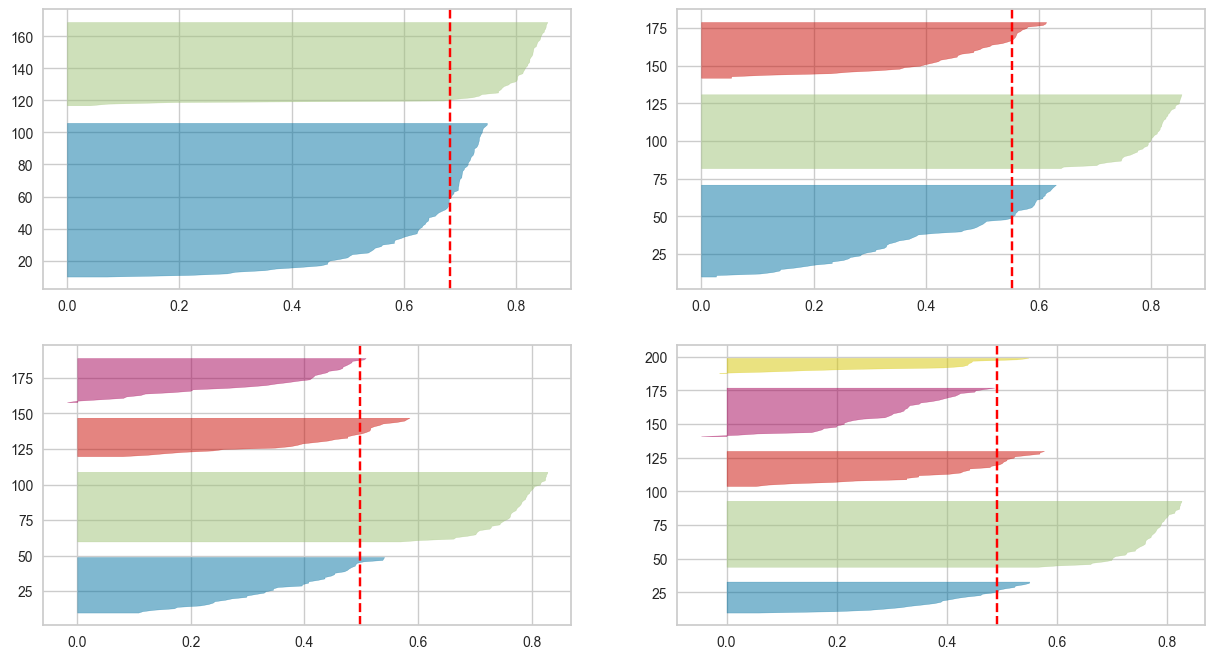
print(scores)[0.6810461692117462, 0.5528190123564095, 0.49805050499728737, 0.49123997967644784]