k-means Clustering

k-means Clustering
Mahmood Amintoosi, Fall 2026
Computer Science Dept, Ferdowsi University of Mashhad
Definition of Clustering
A clustering of a set of datapoints is a partition of the datapoints into k disjoint subsets (or clusters) in such a way that datapoints in the same group are more similar (in some specific sense defined by the analyst) to each other than to those in other groups (clusters).
Representative-based Clustering
Given a dataset with points in a -dimensional space, , and given the number of desired clusters , the goal of representative-based clustering is to partition the dataset into groups or clusters, which is called a clustering and is denoted as .
For each cluster there exists a representative point that summarizes the cluster, a common choice being the mean (also called the centroid) of all points in the cluster, that is,
where is the number of points in cluster .
k-means Clustering
k-means clustering is Representative-based Clustering that partitions the datapoints into k clusters based on their similarity to the centroid of each cluster. The goal of k-means clustering is to find the partition that minimizes the sum of squared distances between each datapoint and the centroid of its assigned cluster.
Lemma 1: Sum of Squared Distances to Any Point
Let be a set of datapoints and let be the centroid of the datapoints. The sum of squared distances of the datapoints to any arbitrary point equals the sum of squared distances to the centroid plus the number of datapoints times the squared distance from the point to the centroid. That is,
Proof:
since .
Corollary 1: Centroid Minimizes Sum of Squared Distances
The centroid minimizes the sum of squared distances since the second term, , is always positive.
Proof:
This follows directly from Lemma 1, since the second term, , is always positive.
Lemma 2: Sum of Squared Distances Between All Pairs of Points
Let be a set of datapoints and let be the centroid of the datapoints. The sum of squared distances between all pairs of points equals the number of points times the sum of squared distances of the points to the centroid of the points. That is,
Proof:
k-means Clustering Algorithm
The k-means clustering algorithm starts with k initial centroids and iteratively updates the centroids and assigns each datapoint to its nearest centroid until convergence.
Initialize k initial centroids randomly.
For each iteration, perform the following steps:
Assign each datapoint to the cluster with the nearest centroid .
Update the centroids as the mean of all datapoints assigned to each cluster.
Repeat step 2 until convergence.
Convergence of k-means Algorithm
The k-means algorithm always converges, but possibly to a local minimum. To show convergence, we argue that the cost of the clustering, the sum of the squares of the distances of each datapoint to its cluster centroid, always improves.
Here is a Python implementation of the k-means clustering algorithm:
import numpy as np

def kmeans(data, k):
    # Initialize centroids randomly
    centroids = data[np.random.choice(range(len(data)), size=k, replace=False)]

    while True:
        # Assign each data point to the closest centroid
        labels = np.argmin(np.linalg.norm(data[:, np.newaxis] - centroids, axis=2), axis=1)

        # Compute new centroids as the mean of all data points assigned to each centroid
        new_centroids = np.array([data[labels == i].mean(axis=0) for i in range(k)])

        # Check for convergence
        if np.all(centroids == new_centroids):
            break

        centroids = new_centroids

    return centroids, labels
Using OOP for implememntation of k-means
This notebook first generates some sample data and defines a KMeansClustering class that implements the K-Means algorithm. The fit method initializes the centroids randomly and then iteratively updates them until convergence.
import numpy as np
import matplotlib.pyplot as plt
from sklearn.cluster import KMeans

# Generate some sample data
np.random.seed(0)
# n_samples = 100
# data = np.random.rand(n_samples, 2)

# Define the KMeans class
class KMeansClustering:
    def __init__(self, k):
        self.data = None
        self.k = k
        self.centroids = None
        self.labels = None

    def fit(self, data):

        self.data = data
        n_samples = len(self.data)
        # Initialize centroids randomly
        self.centroids = self.data[np.random.choice(range(n_samples), size=self.k, replace=False)]

        while True:
            # Assign each data point to the closest centroid
            self.labels = np.argmin(np.linalg.norm(self.data[:, np.newaxis] - self.centroids, axis=2), axis=1)

            # Compute new centroids as the mean of all data points assigned to each centroid
            new_centroids = np.array([self.data[self.labels == i].mean(axis=0) for i in range(self.k)])

            # Check for convergence
            if np.all(self.centroids == new_centroids):
                break

            self.centroids = new_centroids
The following script creates an instance of the KMeansClustering class, fits the model to the data, and plots the data with centroids and labels.
from sklearn.datasets import make_blobs
from scipy.spatial import distance_matrix

# Create an instance of the KMeansClustering class
kmeans = KMeansClustering(k=3)

n_samples = 100
X, y = make_blobs(n_samples=n_samples, centers=3, n_features=2,
                  random_state=0)
# Fit the model to the data
kmeans.fit(X)

# Plot the data with centroids and labels
plt.scatter(X[:, 0], X[:, 1], c=kmeans.labels)
plt.scatter(kmeans.centroids[:, 0], kmeans.centroids[:, 1], marker='*', s=200, c='red')
plt.show()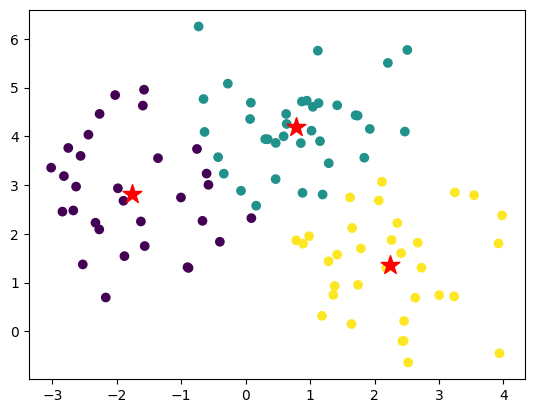
Now, let’s use the Lemma 2 to prove that the centroid minimizes the sum of squared distances
function lemma_2 implements the Lemma 2. The lemma states that the sum of squared distances of all data points is equal to the number of data points times the squared distance from the centroid to the mean of the data points. The notebook tests the lemma on a subset of the data (cluster 0).
def lemma_2(data, centroid):
    n = len(data)
    sum_squared_distances_to_centroid = np.sum((data - centroid) ** 2)
    # Compute pairwise distances
    distances = distance_matrix(data, data)
    sum_squared_distances_of_all_points = np.sum(distances**2)/2
    print(sum_squared_distances_of_all_points, n * sum_squared_distances_to_centroid)

# Test the lemma for  cluster 0
centroid = kmeans.centroids[0]
lemma_2(X[kmeans.labels == 0], centroid)
1812.8736866847603 1812.8736866847605