Fundamentals
Import modules:
import networkx as nx
import numpy as np
import matplotlib.pyplot as plt
import pandas as pd
from scipy import stats

pd.set_option('display.max_colwidth', 200)
%matplotlib inline
What is a Graph?
Definition: A graph consists of a collection of vertices and a collection of links , for which we denote . Each link is said to connect two vertices, which are called its endpoints. If connects , we write . In this case, the vertices and are called adjacent.
def first_graph():
    G = nx.Graph()
    node_labels = [0,1,2,3,4]
    edge_labels = [(0, 1), (0,2), (1,2), (1,2), (2,3), (3,4), (1,3)]
    G.add_nodes_from(node_labels)
    G.add_edges_from(edge_labels)
    return G
G = first_graph()nx.draw_networkx(G)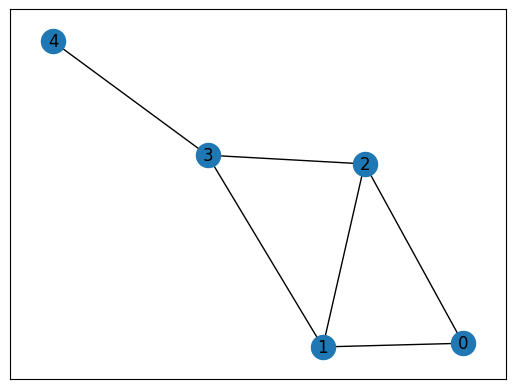
pos = nx.layout.circular_layout(G)
plt.figure(figsize=(4, 4), facecolor='w')
nx.draw(G, pos, with_labels=True, node_size=400, node_color='skyblue', edge_color='gray')
plt.axis('off')
plt.show()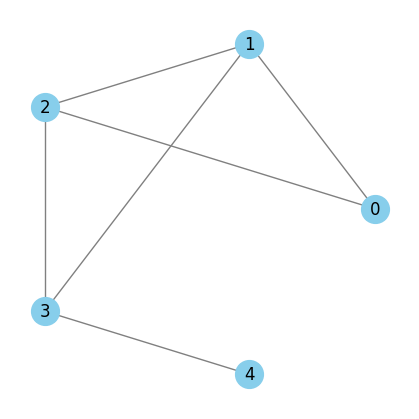
print(G.number_of_nodes(), G.nodes())5 [0, 1, 2, 3, 4]
print(G.number_of_edges(), G.edges())6 [(0, 1), (0, 2), (1, 2), (1, 3), (2, 3), (3, 4)]
print(2 in G, 7 in G)True False
G.degree([0, 1])DegreeView({0: 2, 1: 3})G.adj[0]AtlasView({1: {}, 2: {}})G.add_edge(1,4)nx.draw(G, pos, with_labels=True)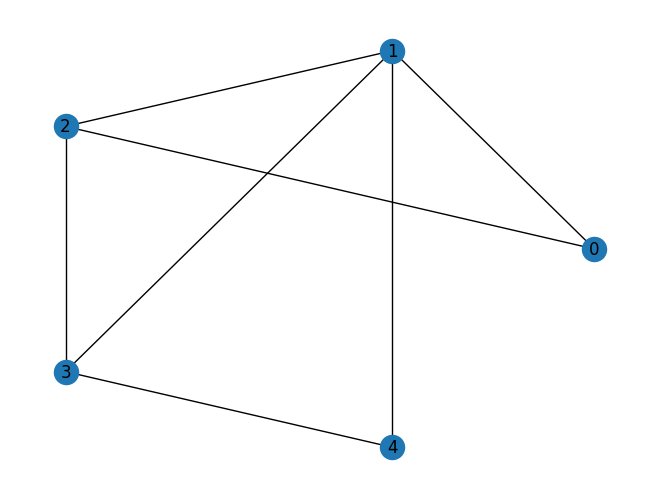
G.remove_edge(1,3)
nx.draw(G, pos, with_labels=True)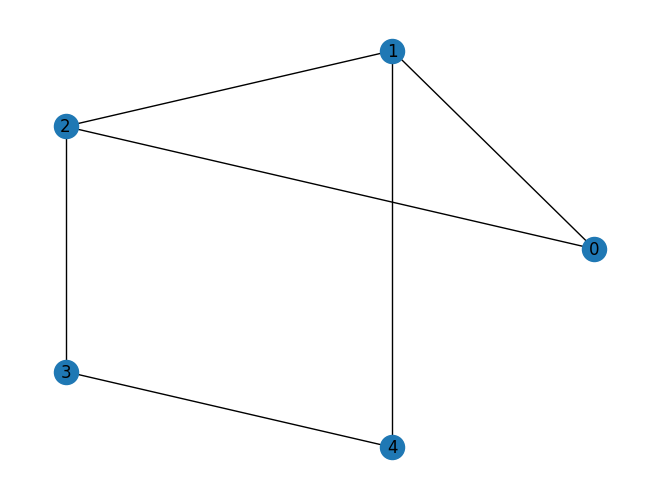
G.remove_node(3)
nx.draw(G, pos, with_labels=True)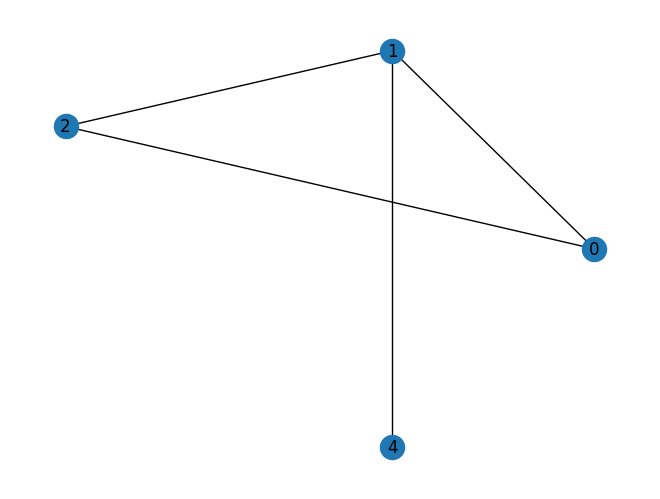
H = GG.add_edge(0,4)
nx.draw(H, pos, with_labels=True)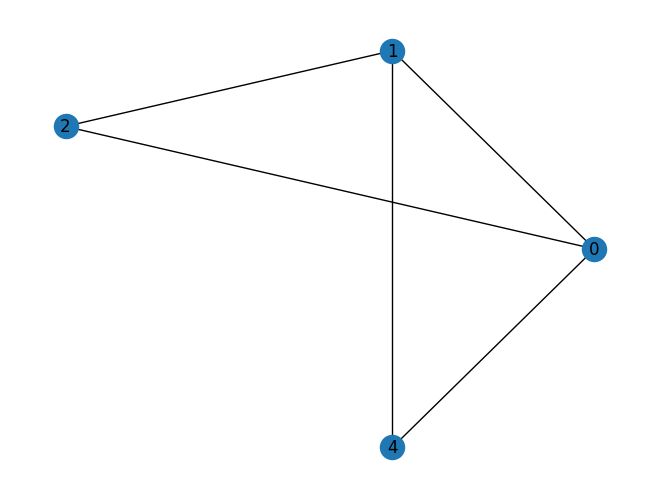
The complement of a graph , denoted as is the graph obtained by removing all links and connecting exactly those vertices that are not adjacent in .
Of course, if we take a graph and its complement and join them, we obtain a complete graph.
G = first_graph()Gc = nx.complement(G)fig, axs = plt.subplots(figsize=(4,4), facecolor='w', nrows=1, ncols=1, constrained_layout=True)
nx.draw_networkx_nodes(Gc, pos, linewidths=1, ax=axs, node_size=400)
nx.draw_networkx_edges(Gc, pos, width=1, ax=axs)
axs.axis('off')(-0.9989638474274827,
1.1899467909320232,
-1.150778381847691,
1.1507784414523377)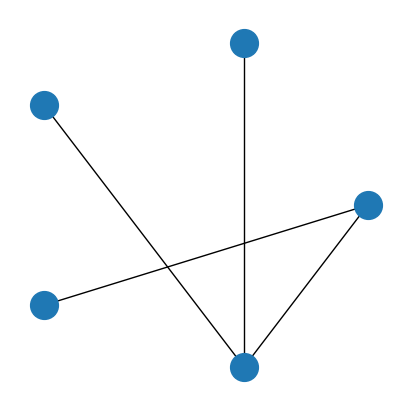
Subgraphs
Definition: A subgraph is a graph with and .
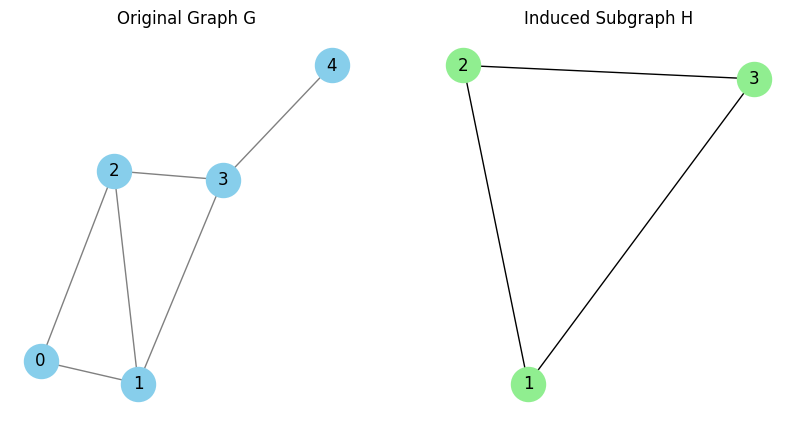
The subgraph of induced by , defined as , is a graph such that .
import networkx as nx
import matplotlib.pyplot as plt

# Create the original graph G
G = first_graph()

# Define a subset of nodes for the induced subgraph
subset_nodes = [1, 2, 3]

# Create the induced subgraph H from G
H = G.subgraph(subset_nodes)

# Use a consistent layout for both graphs
pos = nx.spring_layout(G, seed=42)

# Plot both graphs side by side
fig, axs = plt.subplots(1, 2, figsize=(10, 5))

# Plot original graph G
nx.draw(G, pos, with_labels=True, ax=axs[0],
        node_color='skyblue', edge_color='gray', node_size=600)
axs[0].set_title("Original Graph G")
axs[0].axis('off')  # Hide axis ticks and borders

# Plot induced subgraph H
nx.draw(H, pos, with_labels=True, ax=axs[1],
        node_color='lightgreen', edge_color='black', node_size=600)
axs[1].set_title("Induced Subgraph H")
axs[1].axis('off')  # Hide axis ticks and borders

plt.show()
Graph representations and data structures
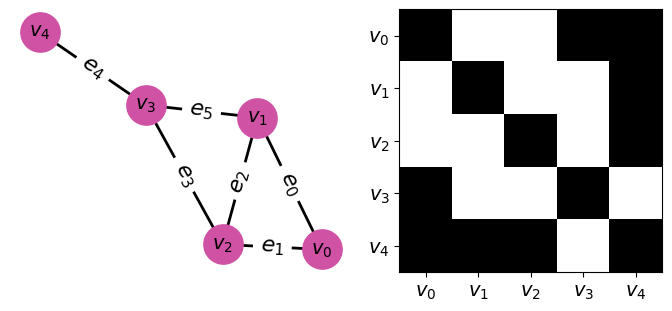
There are different ways to represent a graph. Perhaps the most common is to use an adjacency matrix. Consider a graph with vertices and links. Its adjacency matrix is a matrix with columns and rows with entries denoting the number of links connected by vertices and .
What properties can we see from this example?
An adjacency matrix is symmetric, if for all and , . This property reflects the fact that a link is represented as an unordered pair of vertices (i.e., ). 2. A graph is simple if and only if for each and , and . In other words, there can be at least one link connecting vertices and and, in particular, no link connects to a vertex by itself.
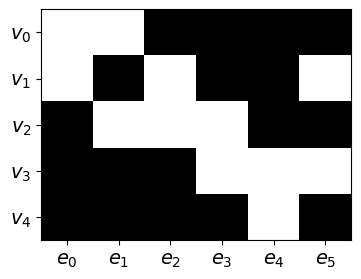
As an alternative, we can also use the incidence matrix of a graph as its representation. An incidence matrix of graph consists of rows and columns such that counts the number of times the link is incident to vertex .
# Define a simple undirected graph
G = nx.Graph()
G.add_edges_from([(0, 1), (0, 2), (1, 2), (2, 3), (3, 4), (1, 3)])

# Get adjacency matrix as NumPy array
A = nx.to_numpy_array(G, dtype=int)
print("Adjacency Matrix:\n", A)
Adjacency Matrix:
[[0 1 1 0 0]
[1 0 1 1 0]
[1 1 0 1 0]
[0 1 1 0 1]
[0 0 0 1 0]]
def incidence_matrix(G):
    nodes = list(G.nodes())
    edges = list(G.edges())
    mat = np.zeros((len(nodes), len(edges)), dtype=int)

    for j, (u, v) in enumerate(edges):
        i_u = nodes.index(u)
        i_v = nodes.index(v)
        mat[i_u, j] = 1
        mat[i_v, j] = 1
    return mat

M = incidence_matrix(G)
print("Incidence Matrix:\n", M)
Incidence Matrix:
[[1 1 0 0 0 0]
[1 0 1 1 0 0]
[0 1 1 0 1 0]
[0 0 0 1 1 1]
[0 0 0 0 0 1]]
📚 Further Reading
If you want more control over layout, labels, and LaTeX-style formatting, refer to the following extended version, which includes:
Custom edge and node labels
Graph drawing alongside matrix visualization
Use of
draw_networkx_edge_labelsanddraw_networkx_labelsLaTeX-style labels for publication-quality figures
def draw_graph_and_adjmatrix(G, node_labels, edge_labels):
  pos = nx.layout.spectral_layout(G)
  pos = nx.spring_layout(G, pos=pos, iterations=20, seed=0)

  fig, axs = plt.subplots(figsize=(7,3), facecolor='w', nrows=1, ncols=2, constrained_layout=True)
  nx.draw_networkx_nodes(G, pos, node_color="#cf52a5", linewidths=1, ax=axs[0], node_size=800)
  nx.draw_networkx_edges(G, pos, width=2, ax=axs[0])
  nx.draw_networkx_labels(G, pos, labels=node_labels, ax=axs[0], font_size=14)
  nx.draw_networkx_edge_labels(G, pos, edge_labels=edge_labels, ax=axs[0], font_size=16)
  axs[0].axis('off')

  A = nx.adjacency_matrix(G)
  axs[1].imshow(A.todense(), cmap='Greys_r')
  axs[1].set_xticks(range(len(node_labels)));
  axs[1].set_yticks(range(len(node_labels)));
  axs[1].set_xticklabels(node_labels.values(), fontsize=14);
  axs[1].set_yticklabels(node_labels.values(), fontsize=14);
  print (node_labels.values())
  axs[1].axis('on')
def example_graph_formalities(node_labels, edge_labels):
G = nx.Graph()
G.add_nodes_from(node_labels)
G.add_edges_from(edge_labels)
draw_graph_and_adjmatrix(
G=G, node_labels=dict({i:"$v_%i$" % i for i in node_labels }), #{1:"$v_1$", 2 :"$v_2$", 3:"$v_3$", 4:"$v_4$"},
edge_labels=dict({(edge_labels[i][0], edge_labels[i][1]) : ("$e_%i$" % i) for i in range(len(edge_labels))})
)node_labels = [0,1,2,3,4]
edge_labels = [(0, 1), (0,2), (1,2), (2,3), (3,4), (1,3)]dict({(edge_labels[i][0], edge_labels[i][1]) : ("$e_%i$" % i) for i in range(len(edge_labels))}){(0, 1): '$e_0$',
(0, 2): '$e_1$',
(1, 2): '$e_2$',
(2, 3): '$e_3$',
(3, 4): '$e_4$',
(1, 3): '$e_5$'}Adjacency matrix
example_graph_formalities(node_labels, edge_labels)dict_values(['$v_0$', '$v_1$', '$v_2$', '$v_3$', '$v_4$'])
Incidence matrix
def get_incidence_matrix(node_labels, edge_labels):
  M = len(edge_labels)
  N = len(node_labels)
  mat = np.zeros(shape=(N,M), dtype=np.int8)
  for i in range(M):
    mat[edge_labels[i][0], i] += 1
    mat[edge_labels[i][1], i] += 1
  return mat

get_incidence_matrix(node_labels=node_labels, edge_labels=edge_labels)
array([[1, 1, 0, 0, 0, 0],
[1, 0, 1, 0, 0, 1],
[0, 1, 1, 1, 0, 0],
[0, 0, 0, 1, 1, 1],
[0, 0, 0, 0, 1, 0]], dtype=int8)fig, axs = plt.subplots(figsize=(4,3), facecolor='w', nrows=1, ncols=1)
axs.imshow(get_incidence_matrix(node_labels=node_labels, edge_labels=edge_labels), cmap='Greys_r', aspect='auto')
axs.set_yticks(node_labels);
axs.set_yticklabels(dict({i:"$v_%i$" % i for i in node_labels }).values(), fontsize=14)
axs.set_xticks(range(len(edge_labels)))
axs.set_xticklabels(dict({(edge_labels[i][0], edge_labels[i][1]) : ("$e_%i$" % i) for i in range(len(edge_labels))}).values(), fontsize=14);